Products
Orbinova Solutions Ltd — United Kingdom
AI development · June 2026 · 7 min read

GTC Taipei:the factory is the product now

At GTC Taipei, Jensen Huang stood in front of Taiwan's manufacturing leaders and described the AI factory as the next industrial asset class. For anyone who works on a plant floor, the most interesting message was in the supporting slides.

Jensen Huang on stage in front of NVIDIA's Physical AI roadmap slide
Huang's roadmap, from perception AI to generative AI to agentic AI to physical AI, presented at the CES 2025 keynote a few months before GTC Taipei. Photo: Wikimedia Commons.
AI development

Twice a year, Jensen Huang walks onto a stage and gives the AI industry a new vocabulary. At GTC Taipei, NVIDIA's keynote on the eve of Computex, the word he kept returning to was 'factory'. The headline use was AI factories: buildings whose product is tokens, measured in output per watt. The quieter thread, and the one that matters most to us, was about actual factories.

Taiwan is the right audience for that thread. TSMC, Foxconn, Wistron, Pegatron, Quanta and Delta run some of the most sophisticated production lines in the world. NVIDIA used the keynote to announce a Taiwan AI supercomputer built with Foxconn and TSMC, a new Taipei headquarters, and, most relevant to anyone who owns a production line, a growing list of Taiwanese manufacturers building Omniverse digital twins of their own plants and fabs.

02The slide that matters: physical AI

The roadmap Huang has been presenting since CES reads like a staircase: perception AI that recognises speech and images, generative AI that produces content, agentic AI that takes multi-step actions, and finally physical AI, models that understand and act in the physical world. Self-driving cars and general robotics sit at the top of that arc.

The robotics announcements made the point concrete. Isaac GR00T, NVIDIA's foundation model family for humanoid robots, gained a new version trained heavily on synthetic motion data, an approach where the model practises in simulation before it ever moves a real arm. Jetson Thor, the edge computer designed to live inside a robot, comes from the same silicon family that runs inference beside a CNC machine or a camera. At the hardware level, the line between a robot's brain and an industrial edge computer has effectively disappeared.

The digital twin message has also stopped being aspirational. When TSMC plans a fab or Foxconn lays out an assembly building, the building now exists in simulation first: airflow, logistics, robot placement, all validated before steel is cut. The twin is no longer a research demo. It is how the world's most capable manufacturers de-risk capital expenditure.

Honda ASIMO humanoid robot facing the camera
Pioneering platforms like ASIMO paved the way. The new generation learns in simulation first.
03What this means on an actual factory floor

It would be easy to watch a keynote like this and conclude that the future belongs to companies that can afford ten thousand GPUs. We read it the other way around. Every announcement pointed at the same architectural pattern, and the pattern is accessible: a physics-aware model of your process, a live digital twin to validate decisions against, and inference at the edge, on the machine, on the camera, on the robot, because the decision loop cannot afford a round trip to a data centre.

That pattern holds whether you are Foxconn building iPhones or a forty-machine job shop in the Midlands. The economics changed at the bottom of the market, not just the top. The same Jetson-class silicon Huang holds up on stage costs less than a single spindle repair, and the protocols a plant already speaks, OPC UA, S7Comm and RTSP, are exactly the interfaces this stack consumes.

The car on the keynote stage and the humanoid robot behind it are the photogenic end of physical AI. The less photogenic end is a plating bath that doses itself before the deposit goes dull, a camera that notices the forklift moving at 2 a.m. when nothing should be, and a record that proves both. That end is buildable today, on hardware you can buy this quarter. It is also, not coincidentally, the half of the keynote we are building.

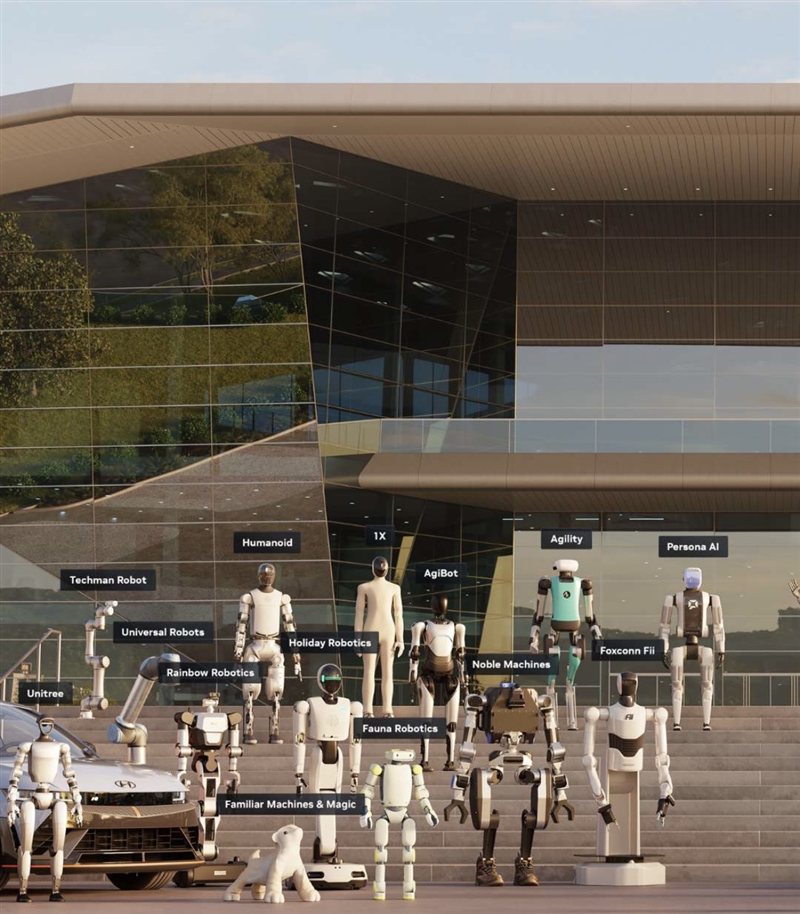
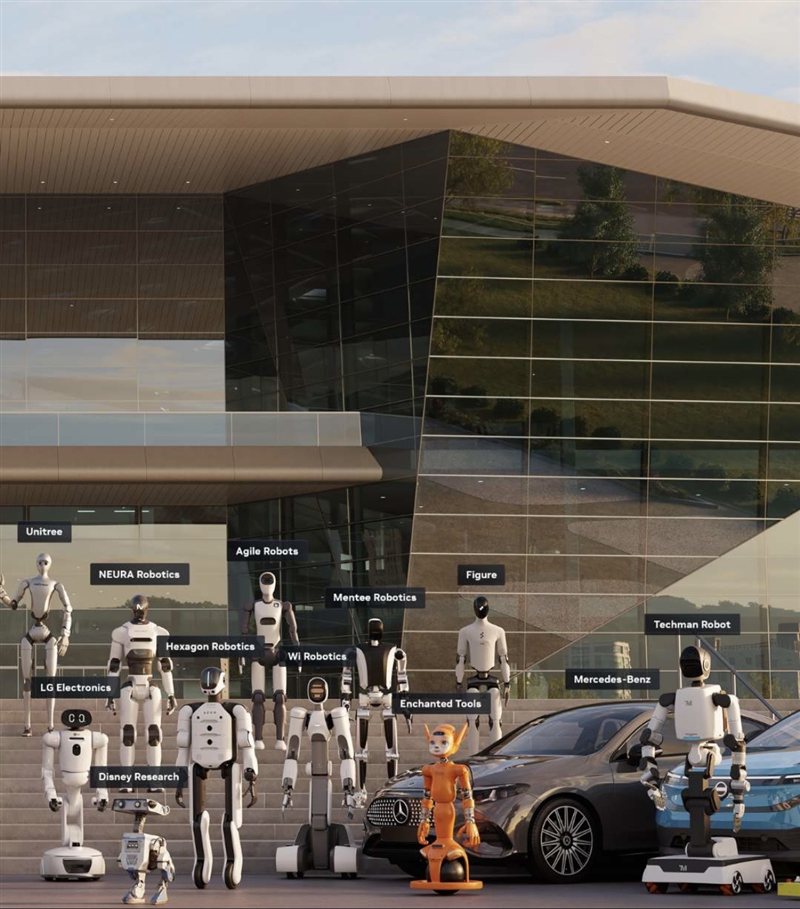
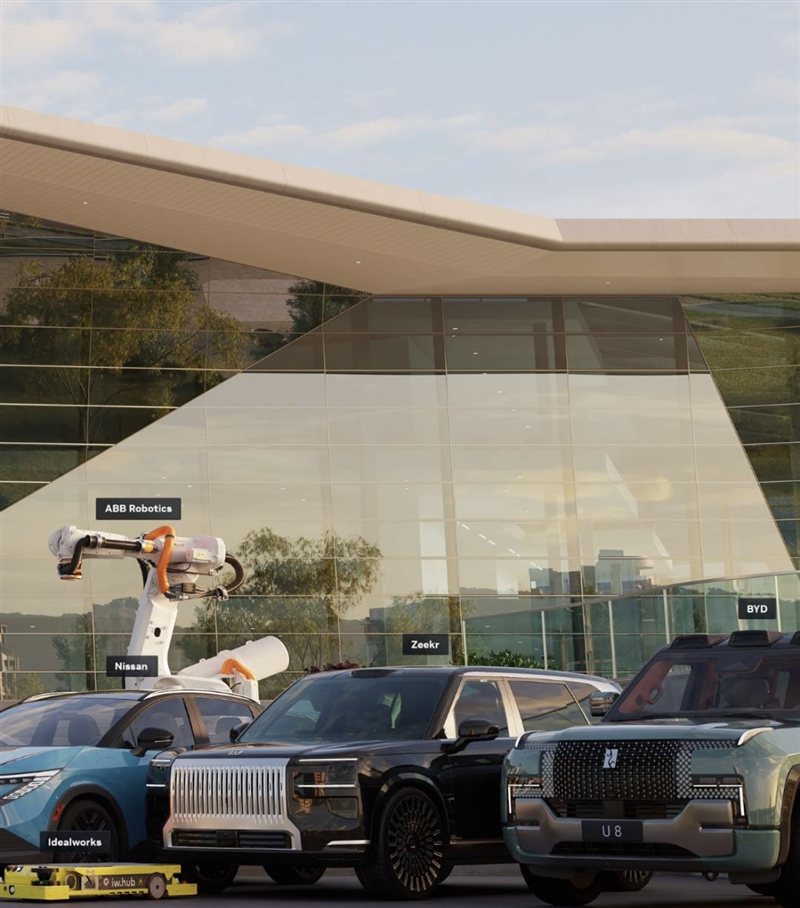
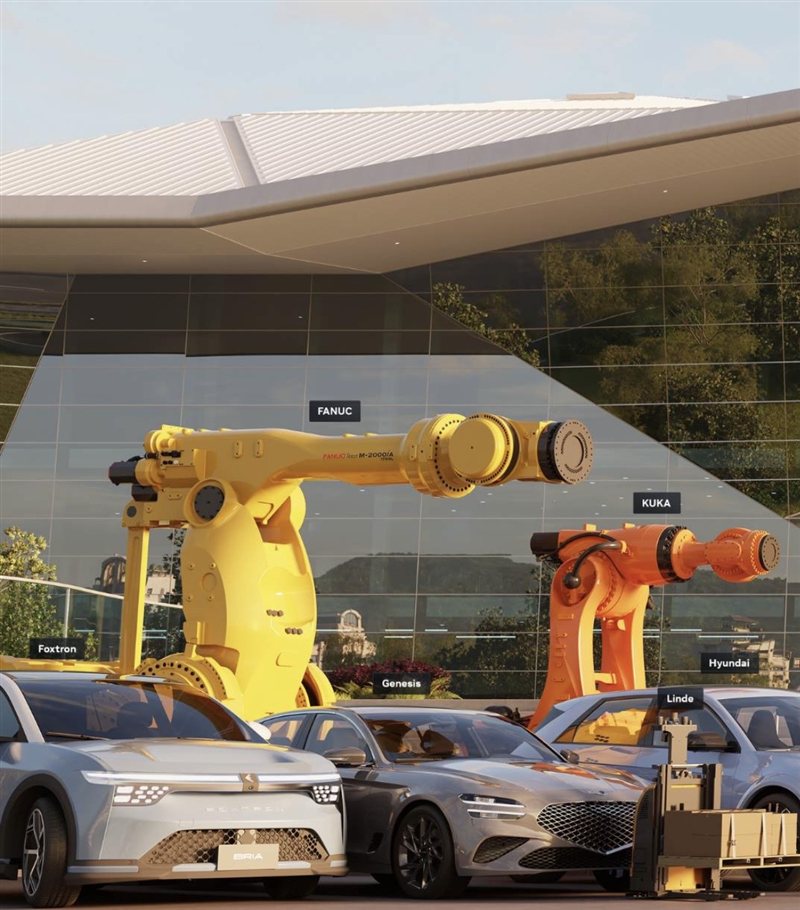
The physical AI family portrait: robot arms, humanoids and vehicles, one ecosystem. Photo: @nvidiarobotics, Instagram.